Our research on the interdisciplinary relationship between work, education, social stratification, culture, well-being and community is reflected in our fruitful dissemination work. Here are some of the most important contributions:
- Postgraduate education
- Monographic and specialised courses
- Transfer agreements
- Institutional agreements
- Collaboration with other teams and institutions
- International Profile
- Recognition of research trajectory
- Strategic Roadmaps
1. Postgraduate education
Teaching in doctoral courses and lines of research is integrated into the programmes of the University of Zaragoza:
- Official Master's Degree in Management, Strategy and Marketing.
- Official Master's Degree in Advanced Studies on Language, Communication and their Pathologies.
- Official Master's Degree in Social Gerontology.
- Official Master's Degree in Occupational Risk Prevention.
- Official Master's Degree in Secondary Education Teaching.
- Official Master's Degree in Global Health.
- Official Master's Degree in Sociology of Public and Social Policies.
- University Specific Master's Degree in Japanese Studies.
- University Specific Master's Degree in Family and Systemic Intervention.
- University of Zaragoza Specific Master's Degree in Industrial Organisation.
With regard to teaching postgraduate courses, we would like to highlight the participation of several group members in the following:
- University of Zaragoza Postgraduate Studies on Agents for Equal Opportunities for Women (see information).
- University Extension Certificate in Citizen Participation Techniques. University Specific Master's Degree (see information).
- Specialisation Diploma in Social Resources and Services Management (see information).
- Specialisation Diploma in Innovation and Evaluation in the field of Social Intervention (see information).
˄ up
2. Monographic and specialised courses
Among the monographic and specialised activities designed and carried out by the group, we have selected the following examples:
- ‘Human capital, integration and rural development’, Teruel (2003). 3 ECTS (European Credit Transfer and Accumulation System) (see poster).
- ‘Environmental risks: Reality or fiction?’, Teruel (2007). 2 ECTS credits (see poster).
- Summer courses, also designed as spaces for group members to meet and reflect. Several books have been published using the materials from these courses, financed with the corresponding aid for research groups from the Government of Aragon (see publications):
- ‘Bodies that speak: Genders, identities and social representations’, Jaca, University of Zaragoza (2006). 2 ECTS credits (see programme).
- ‘Social psychology and well-being: An interdisciplinary approach’, Jaca, University of Zaragoza (2007). 3 ECTS credits (see programme).
- ‘Citizen participation and cooperation. Building active citizenship through volunteering’, Teruel, University of Zaragoza (2013). 2 ECTS credits (see programme).
- ‘Business and third sector collaboration through CSR and volunteering’, Jaca, University of Zaragoza (2016). 2 ECTS credits (see programme).
- ‘Active and healthy ageing: A multidisciplinary approach’, Jaca, University of Zaragoza (2018). 2 ECTS credits (see programme).
- Innovation and Technologies: Challenges for human resources and social capital in organisations’, Jaca, University of Zaragoza (2019). 2 ECTS credits (see programme).
- ‘Healthy organisation. Healthy human resources practices. The role of social economy’, Teruel. University of Zaragoza (2020). 2 ECTS credits (see programme).
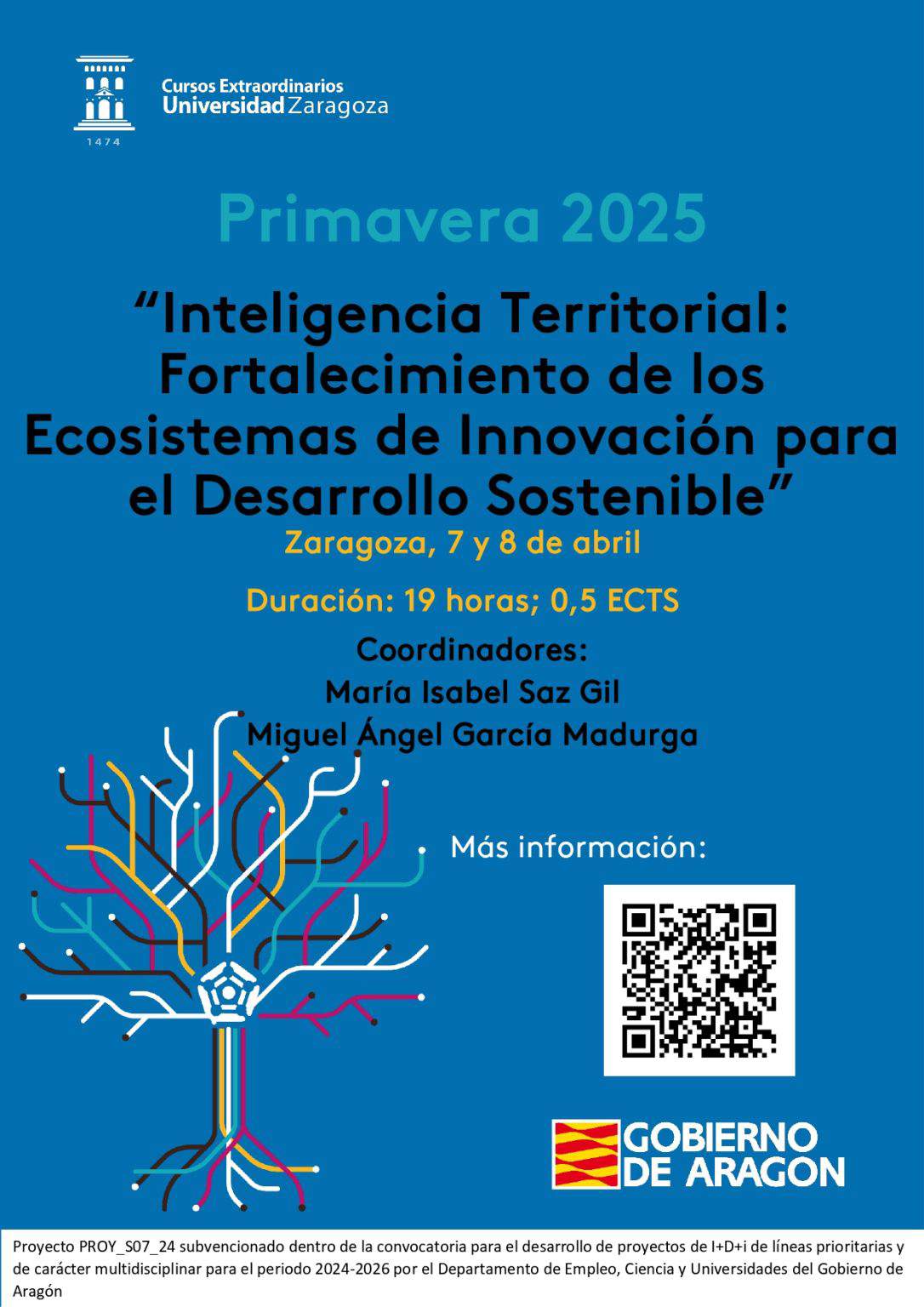
- ‘Territorial intelligence: Strengthening innovation ecosystems for sustainable development’, Zaragoza, University of Zaragoza (2025). 2 ECTS credits (see poster).
- ‘Slow living, a healthy model of development’, Rubielos de Mora, Teruel (2010). 2 ECTS credits approved by the University of Zaragoza (see programme).
- Health, Well-being and Quality of Life Conference, La Coruña, University of La Coruña (2010) (see poster).
- Organisation of the 34th ICAF International Conference ‘Food and love. Interdisciplinary perspectives’, Teruel-Daroca-Murero, 8-11 May 2012.
- Organisation of the 1st International Congress on Healthy Organisations Psychology, Huesca, 8-10 November 2018.
- Organisation of the International Scientific Meeting on Healthy Organisations (HealthyOrg). Emerging Trends in Corporate Social Responsibility and Strategic Human Resource Management, Zaragoza, 7-8 July 2022 (see video).
- Training programme ‘Corporate social responsibility and social innovation: commitment to the health and well-being of human resources in organisations’, hosted on the Campus Iberus Moodle e-learning platform, September 2022 (see programme).
- Training programme ‘Women's Entrepreneurship and Leadership for Peace’, hosted on the Campus Iberus Moodle e-learning platform. The course is part of the Diploma in Women's Entrepreneurship and Leadership for Peace in Soacha and Bogotá (Colombia). 80 synchronous and diachronic hours, October and November 2023.
- Carolina Foundation-Campus Iberus training programme: ‘Professional skills for leadership, innovation and sustainable development’, Zaragoza (2024).
- ‘Training in Artificial Intelligence applications to Human Resources’, (2024-25). 2 ECTS credits (see information).
Teachers from the research group also collaborate in the organisation and teaching of international seminars, such as the Erasmus intensive programme: ‘Social Work Confronting New Right Wing Movements In Europe’, held in Nuremberg (Germany) in 2011. This course also involved the participation of teachers and students from seven European countries: Austria, Germany, Belgium, Denmark, the Czech Republic and Hungary. Content: ‘Social work as a profession defending human rights’, ‘Analysis of the situation of new far-right movements in different European countries: Political, social and cultural, personal and professional dimensions, and how to address this situation through social work’. This 4 ECTS credits course was certified by the University of Zaragoza.
This meeting continued in subsequent academic years, with a commitment to volunteering for social change as a new thematic focus: ‘Volunteer Engagement in Europe: Norms and Values’ (5 ECTS credits); ‘European Union Programme. Education and Culture DG (Directorate General). Lifelong Learning Programme’ , participating universities from Germany, Finland, Wales, Poland and Spain, in Nuremberg (Germany), 2012; ‘Volunteer Engagement in Europe: Social Change’ (5 ECTS credits), and ‘European Union Programme. Education and Culture DG. Lifelong Learning Programme’ participating universities from Germany, Finland, Wales, Poland and Spain, in Lodz (Poland), 2013.
˄ up
3. Transfer agreements
˄ up
4. Institutional agreements
For the completion of professional internships:
˄ up
5. Collaboration with other teams and institutions
Nowadays, one of our main concerns is the scientific and social dissemination of our work and coordination with other research groups. This process is reflected in the CVs of both the group and its members at the national and international levels:
- Collaborator with the Research Institute for Personnel Psychology, Organisational Development and Quality of Working Life (IDOCAL) at the University of Valencia.
- Director of the Ibón Centre for Health Prevention and Promotion in Sabiñánigo (Huesca) since 1997.
- Member of the Social and Environmental Capital research group. Aragonese Environmental Education Strategy Network. Government of Aragon, 2003.
- Member of the Spanish Association for Applied Social Research in Sport (AEISAD), 2000.
- Member of the Lifestyle and Health, a Community Approach research group. Directory of research work on physical activity and sport in Aragon, 2004.
- Member of the GIIS092 group - Relational Leadership in Healthcare (Aragon Health Research Institute), 2019.
- Member of the International Group for the Cultural Studies of the Body (CORPUS).
- Member of the Invictus research Group at the University of Barcelona.
- Member of the European-Latin American Interuniversity Network for Applied Studies, 2001.
- Member of the Board of Directors of the International Commission on the Anthropology of Food and Nutrition (ICAF). International Union of Anthropological and Ethnological Sciences (UNESCO), 2007.
- Member of the Aragonese Institute of Anthropology. Federation of Anthropology Associations of Spain, 2000.
- Treasurer of the International Commission on the Anthropology of Food and Nutrition of the International Union of Anthropological and Ethnological Sciences, 2001.
- Vice-president of the research group Society for the Interdisciplinary Study of Food and Social Habits, 2005.
- Member of the Campus Iberus HealthyOrg Action Group, 2013.
- Member of the University Institute for Research on Heritage and Humanities, 2020.
- Member of the University Institute for Research on Employment, Digital Society and Sustainability at the University of Zaragoza, 2021.
˄ up
6. International Profile
The group's research is backed both by its track record in recent years and by its current projects, which also shape our future as a team.
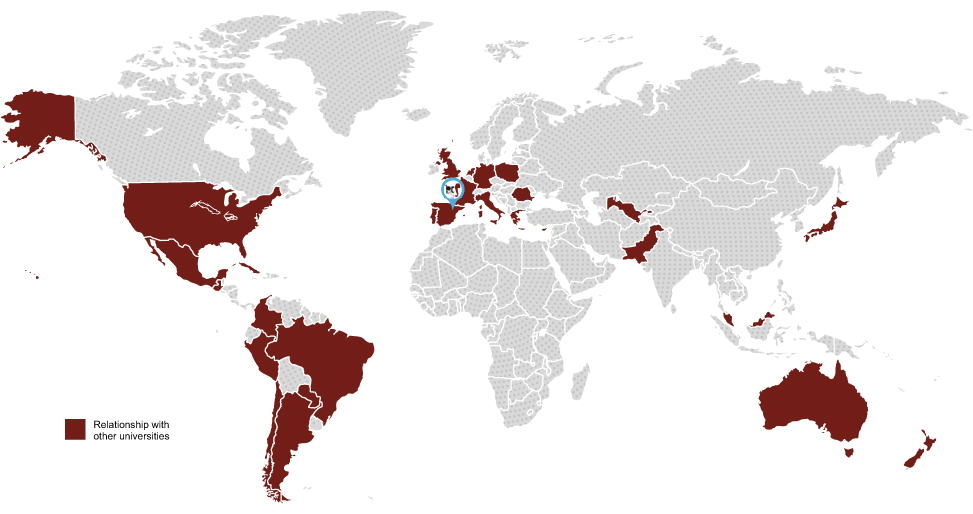
Examples of this international projection include the grants, scholarships, international stays and awards that team members have received from various academic and governmental bodies in recent years.
International research scholarships and/or stays:
- Germany: Technische Universität Berlin and University of Regensburg.
- Argentina: National University of San Luis.
- Australia: University of Sydney.
- Brazil: University of Brasilia.
- Chile: University of Chile.
- Cyprus: Cyprus International Institute of Management.
- Colombia: University of Ibagué and National University of Antioquia.
- Cuba: University of Havana and University of Oriente.
- United States: City University of New York, Eastern Illinois University, John Jay College of Criminal Justice, University of California Riverside, University of Chicago, Cornell University (Ithaca) and University of Rhode Island.
- France: École des Hautes Études en Sciences Sociales (Paris), Université Catholique de Lille, Université Stendhal (Grenoble) and Université de Toulouse.
- Greece: Athens University of Economics and Business.
- Guatemala: Rafael Landívar University.
- Italy: University of Bologna, Sapienza University of Rome and University of Teramo.
- Japan: Universities of Hyogo, Kyoto, Meiji, Sophia and Wakayama.
- Mexico: Autonomous University of Yucatán, Autonomous University of Zacatecas and Autonomous University of the State of Mexico (Toluca).
- New Zealand: University of Auckland.
- Netherlands: Inholland University of Applied Sciences and Tilburg University.
- Paraguay: National University of Asunción.
- Peru: University of Lima.
- Poland: Faculty of Educational Sciences (Lodz).
- Portugal: ISCTE-Instituto Universitário de Lisboa, Lusófona University of Porto.
- United Kingdom: London School of Economics and Political Science, University of Belfast and University of Edinburgh.
- Romania: University of Bucharest.
˄ up
7. Recognition for research trajectory
- RUNNER-UP AWARD 1997-98: ‘A model for community analysis in urban contexts: participation, belonging and social needs’. IV Social Welfare Research Award. University School of Social Work and Official Association of Graduates in Social Work and Social Affairs. University of Valencia.
- FIRST PRIZE 2002: IV Conde Aranda Prize for Citizen Participation. Zaragoza City Council (Casablanca, Zaragoza).
- 2008 EXCELLENCE AWARD for the research project ‘Economic analysis of risk behaviours: Alcohol consumption and sexually transmitted diseases’. Awarded by the committee and jury of the Health Economics Association and officially announced during the 28th Health Economics Conference.
- 2012 Antonio Beristain Victimology Research Award from the University of the Basque Country: ‘Threatened by ETA (Basque Country and Freedom Group) in the Basque Country: an approach to the scientific study of victimisation’.
- 2013 Professor Mariano Yela Award from the Spanish Society of Legal and Forensic Psychology for new researchers in legal psychology.
- FIRST PRIZE 2014 for the second semester for the research work entitled ‘Protective factors for positive mental health in adolescents’, awarded at the Doctorate in Health Sciences Research Colloquium by the Autonomous University of the State of Mexico (Toluca, Mexico).
- 2024 Espiral International Education and Innovation Award from the Espiral Education and Technology Association.
- 2024 Enrique Fuentes Quintana NATIONAL AWARD, Political Science, Sociology and Communication category: ‘Civic participation as a promoter of well-being for older people in Europe’.
- THIRD CREAR AWARD 2024 from the Government of Aragon.
- NATIONAL AWARD 2025 for Research on Volunteering from the Secretary of State for Social Rights.
- Outstanding Doctorate Awards:
- 2002 Call: University of Zaragoza (Social Sciences Department).
- 2002 Call: Economic and Social Council of the Community of Aragon (AWARD for the doctoral thesis ‘Organisational study of the adoption of teleworking. Empirical analysis of explanatory variables of its viability and dissemination’).
- 2003 Call: University of Valencia (Faculty of Psychology).
- 2004 Call: University of Barcelona (Faculty of Anthropology).
- 2004 Call: University of Zaragoza (Faculty of Economics and Business Studies).
- 2006 Call: Economic and Social Council of the Community of Madrid.
- 2025 Call: Economic and Social Council of the Community of Aragon (AWARD for the doctoral thesis ‘Care for dependency and promotion of personal autonomy: An analysis of young people with severe and profound disabilities in the Aragonese context’).
˄ up
8. Strategic Roadmaps
In the future, we intend to continue our ongoing research and design new projects. We will focus on three issues for which we are seeking funding from various governmental and non-governmental entities:
- Training of group members, contact with other research networks as well as international and national scientific forums. Since 2006, members of the team have participated in the National Agency for Evaluation and Prospective Studies (ANEP), providing advice and consultation on the evaluation of research projects.
- Publication of research results. In addition, some members of the group also work in the scientific councils of journals, such as:
- Dissemination of these results through the production of audiovisual materials.
The Well-being and Social Capital research group is open to new collaborations. If you are interested in working with us, you can contact the relevant team member directly via the members page.
˄ up